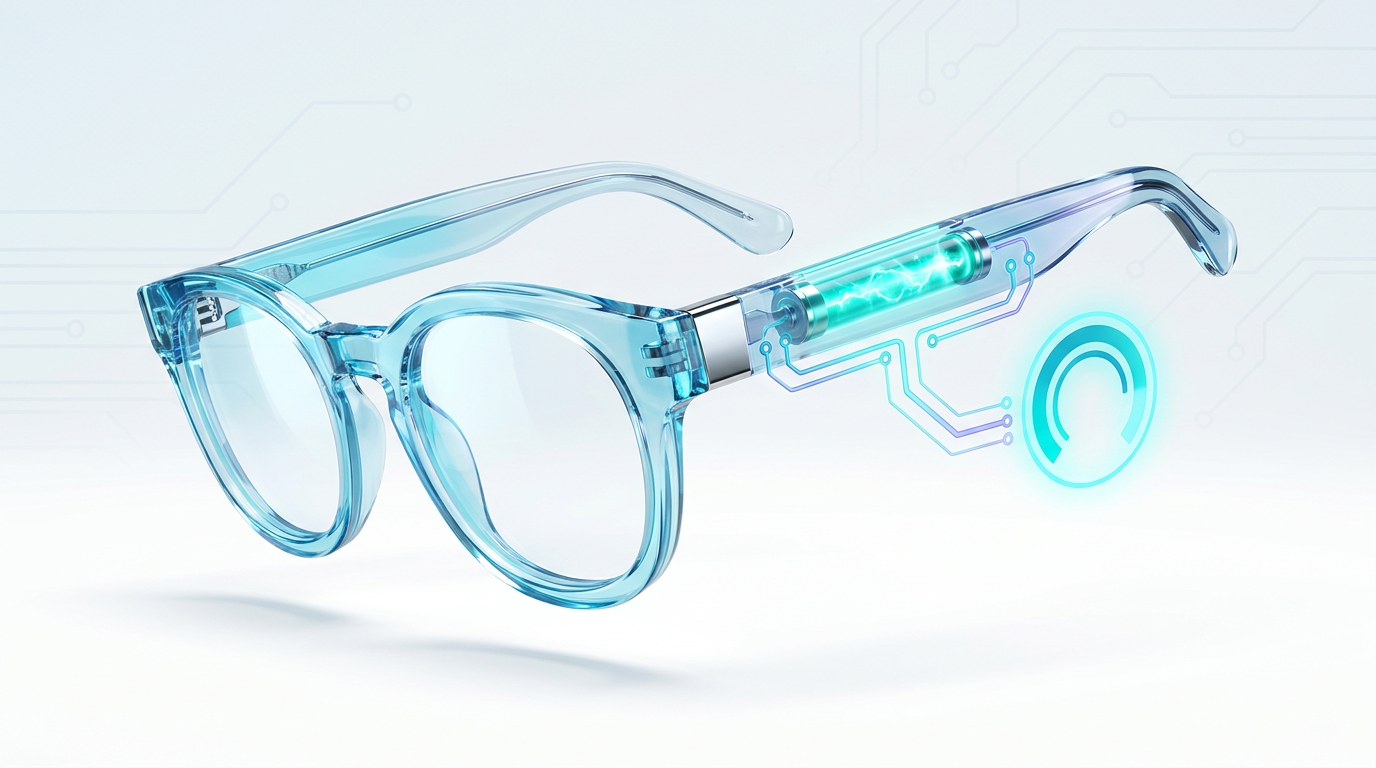
Smart glasses like this Ray Ban Meta Und Oakley Meta Vanguards You need to pack enough power to power features like cameras, Lautsprecher, KI-Workloads, und sogar eine Anzeige. But everything has to fit into the temples of the glasses.
So how do you fit a battery with enough power to power smart glasses all day into a form factor narrower than an adult’s pinky finger? We need to rethink how batteries are made.
In Episode 86 of the Meta Tech Podcasthost Pascal Hartig sat down with Karthik and Myuran, the engineers behind Meta’s steel can battery technology, to talk about powering the latest and next generation of wearables.
Why conventional batteries are not enough for smart glasses
Traditional pouch cells – the batteries in most phones and laptops – are inadequate for devices like smart glasses because they are difficult to reshape and shrink. Their folds waste volume, their tolerances eat up precious millimeters of space, and at smaller sizes they can struggle to provide peak performance for multitasking (z.B. someone using the camera and asking the AI model to perform a task at the same time).
Smart glasses require a battery that can take up every micrometer of space – something rigid, precise and tailored to the product and not the other way around.
Enter Steel Can Cells (at Unprecedented Widths)
Steel can batteries are not new. They use power tools and watches. But Meta’s AI glasses required batteries just 7mm wide, narrower than anything that had come before. To get there, almost all of the battery’s internal components had to be rethought.
The electrode architecture
Conventional tubular steel cells use a wound “jelly roll” of electrode material. Meta’s engineers replaced this with stamped stacked layers, similar to connecting small resistors in parallel. The result is significantly lower impedance, which is important when peak power is required, allowing the device to avoid voltage drops when a lot of power is needed at the same time (because someone might be taking a recording and asking the AI a question at the same time).
Tolerances
A steel can cell retains its shape down to about 100 micrometers. With a 10 mm wide battery, this actually results in usable volume, which is directly reflected in additional energy density and running time.
With every generation new challenges
From Gen 1 to Gen 2 of the Meta Ray-Ban, the cell capacity grew from 160 mAh to 210 mAh – about a 30 percent increase. Jedoch, the product shipped with the claim that it doubled the runtime. The chemistry hasn’t changed. The additional gains came from system-level efficiency improvements in hardware and software, wie zum Beispiel: B. better power management, tighter firmware control and a form factor that allowed for a larger cell
The Oakley Meta Vanguards actually have a battery in each temple arm, which poses a real system puzzle at the intersection of electrical, firmware and mechanical engineering. The cells in each bracket arm are symmetrical, but the electronic loads are not evenly distributed between the two sides. This leads to cross-loading risks and complex boot and shutdown sequencing.
Then the Meta Ray-Ban display glasses introduced the most demanding performance profile yet. Its screen consumes power continuously rather than in short bursts, which required the development of a 248mAh steel case cell, the largest in Meta’s lineup.
More power for wearables
The ultra-narrow steel can approach we developed for our smart glasses proves adaptable to other form factors across Meta’s hardware portfolio.
Meta is now focused on scaling and democratizing this technology across multiple vendors to ensure we have a stable supply and can integrate these batteries into the next generation of wearables.
Listen to the full episode to hear the complete story – from initial sketch to global shelf – including details on dual-battery mutually charging systems, software versus hardware iteration cycles, and what it’s really like to collaborate across time zones to create something the world has never seen.
Listen now
You can also find the episode wherever you get your podcasts, einschließlich:
Timestamp
- 0:06 – Introduction and news
- 1:49 – Guest introductions
- 4:16 – The problem with existing batteries
- 6:40 – Bag or steel can batteries
- 10:27 – What lower impedance means
- 12:25 – Electricity requirement
- 16:02 – Synchronizing two batteries
- 23:11 – Creating unprecedented batteries
- 28:12 – Software vs. hardware iteration cycles
- 30:51 – Collaborations around the world
- 37:00 – Market Compliance
- 42:24 – Outro
Der Meta Tech Podcast is a podcast from Meta where we highlight the work of Meta engineers at all levels – from low-level frameworks to end-user features.
Send us feedback Instagram, Themenoder X.
And if you want to learn more about career opportunities at Meta, visit the Meta Careers page.