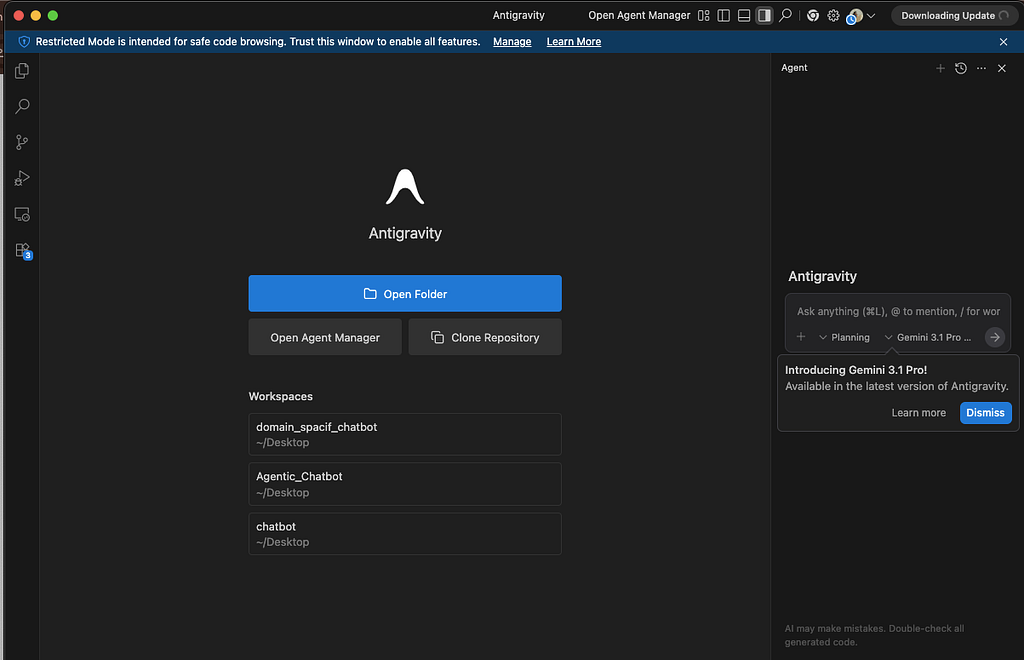
We have all deployed AI “co-pilots.” They are great at finishing our sentences or writing a short function. But let’s be honest – sometimes it feels like you’re still doing 90% of the hard work.
Input Google Antigravity.
Released as an “agentic” development platform, Antigravity is not just another IDE (Integrated Development Environment). It’s a mission control center where AI agents don’t just work suggest Code – them plan, execute and review it for you.
As someone who spends a lot of time with Gemini and Agentic AI, I wanted to see if this lived up to the hype. Here’s everything you need to know to get started.
![图片[1]-Google Antigravity: Beginner Guide to the New Agentic IDE (Step-by-Step + Real Use Case) For Windows 7,8,10,11-Winpcsoft.com](https://winpcsoft.com/wp-content/plugins/wp-fastest-cache-premium/pro/images/blank.gif)
1. What exactly is Google Antigravity?
Think of Antigravity as a branch of VS Code “supercharged” for agents. While traditional editors have a chat sidebar, Antigravity introduces two main views:
- The editor view: This looks familiar (it’s based on VS Code). Here you and the agent code together.
- The manager view: This is “Mission Control”. Here you can watch several agents working in parallel. One agent might rework your database while another creates a UI component.
The “magic” is that these agents can use the terminal, search the Internet for documentation, and even open a built-in Chrome browser to test the user interface they have just created.
2. How to install it (step by step)
“Withdrawing” is surprisingly easy.
- Download: Go over to antigravity.google and download the installer for your operating system (Windows, macOS or Linux).
- Initial setup: When you first start it, you have the option to import your settings from VS Code or Cursors. If you want a clean experience, I recommend Start Fresh.
- Choose your “Agent Mode”: You will be asked how much autonomy you want to give the AI. I suggest “Agent-assisted development.” This allows the agent to run terminal commands, but keeps you up to date when major changes are approved.
- Connect your account: Sign in with your Google account to take advantage of the power of Gemini 3 Prowhich serves as the “brains” of the editor.
3. Best Use Case: Creating a “Personal Finance Dashboard”
Let’s look at a real-world example of how this changes your workflow. Instead of writing code line by line, delegate it entire Special feature.
The request
In the agent panel I set myself this overarching goal:
“Create a Next.js app called FinancePulse.” It needs a dashboard that shows risk profiles for savings, stocks and cryptocurrencies. Use Tailwind CSS and shadcn/ui. Make it look professional and responsive.”
This is how the agent reacts:
- Planning: The agent doesn’t just start typing. It creates a Plan Artifact (a checklist). It says: “First I create a framework for the project, then I install dependencies, and then create the UI components.”
- Version: Once you click Accept, the terminal will open, run npx create-next-app, install your libraries, and start creating files.
- Self-correction: If the agent encounters an error during installation, it will not stop. It reads the error, looks for a solution and tries again.
- Examination: The agent opens its built-in browser, navigates to localhost:3000, and checks that the dashboard looks correct. It even requires a screenshot for you to view!
4. Why this is a game changer
As someone who works closely with us Gemma and other open LLMs, I am particularly impressed by how Antigravity works context. Since it is based on Gemini 3, it can “see” your entire codebase (up to 1 million tokens). You don’t have to keep copying code into a chat box; The agent already knows where everything is.
It’s not perfect – it’s still in preview – but it represents a shift Coding To orchestrate.
Limitations (Important)
To use it effectively, you should know the following:
- It’s still there Early stage/preview
- The output is not always perfect – supervision is required
- Clear instructions are crucial
- Complex architecture still requires human design thinking
Antigravity is powerful, but not autonomous enough to replace engineering judgment.
Best practices
To achieve better results:
- Be specifically in your command prompt
- Break down complex problems smaller goals
- Check agent output frequently
- Run the agent instead of restarting it
Google Antigravity: Beginner Guide to the New Agentic IDE (Step-by-Step + Real Use Case) was originally published in Google Developer Experts on Medium, where people are continuing the conversation by highlighting and responding to this story.