![imagen[1]-La IA de Vertex se ha ido. Esto es lo que Google construyó en su lugar. For Windows 7,8,10,11-Winpcsoft.com](https://winpcsoft.com/wp-content/plugins/wp-fastest-cache-premium/pro/images/blank.gif)
At Cloud Next 2026 in Las Vegas, Google made one of the biggest moves in its cloud history. Vertex AI, the platform that millions of developers have been using since 2021, is gone. Not outdated. Not just renamed. Structurally replaced with something built from the ground up for a different era.
It’s called Gemini Enterprise Agent Platform.
And when you build something with AI today, you need to understand what just changed.
The Old World versus the New World
Vertex AI is designed for a world where you choose a model, train it, deploy it, and call it a day. One model, one job, one endpoint.
This world is over.
Companies today are not trying to develop a single AI assistant. They’re trying to run hundreds, sometimes thousands, of AI agents at the same time. Agents searching the web, writing emails, calling APIs, talking to each other, processing customer requests, and making decisions—all at the same time, all day long.
This is not what Vertex AI was designed for. So Google replaced it.
What is the Gemini Enterprise Agent Platform?
Google boss Thomas Kurian described the strategy in simple terms in the keynote. Competitors, he said, “give you the pieces, not the platform.” Google wants to own the entire stack, from its custom TPU chips to the three billion inboxes in Google Workspace.
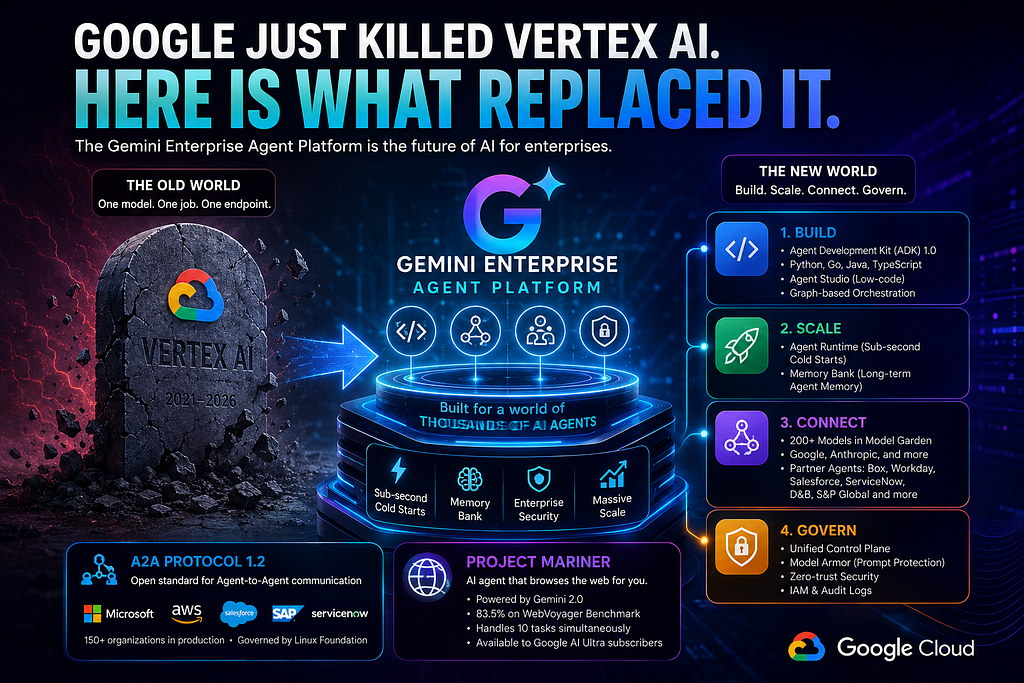
The result is the Gemini Enterprise Agent Platform. It brings together model selection, development tools, deployment infrastructure, security and governance in a single place. Everything you need to create, run and manage agents under one roof.
Además, Agentspace, Google’s enterprise AI search and discovery product, has been integrated into a unified Gemini Enterprise offering. No more juggling with individual products.
The four things the platform does
The platform is organized around four core tasks.
The first is construction. For developers who want to write code, there is the Agent Development Kit, or ADK for short. It has just been released in stable version 1.0 for four languages: Pitón, Go, Java and TypeScript. This is significant. Corporate teams don’t always work in Python. A Java shop can now create production-ready agents without maintaining a separate Python service just to connect to Google infrastructure. ADK now also includes a graph-based framework for orchestrating multi-agent collaboration.
For teams that don’t want to write any code at all, there’s Agent Studio. It’s a low-code interface where you describe what you want in plain English and the platform helps you create it. Non-technical teams within an organization can now create agents without submitting a ticket to engineering.
The second is scaling. There’s a feature called Agent Runtime that Google says allows for a cold start in less than a second, meaning new agent instances spin up almost immediately as demand increases. There is also a new memory bank. This gives agents a persistent long-term memory across sessions. Previously, every time you started a new conversation with an agent, you had no idea what had happened before. Memory Bank fixes this. An agent can now remember the context from a week ago and respond to it today.
The third is connection. There are now over 200 models in the Model Garden, including Google’s own Gemini models as well as Anthropic Claude and many others. Además, partner agents from Box, Workday, Salesforce, ServiceNow, Dun and Bradstreet and S&P Global are already integrated. You don’t have to build everything from scratch. If you need an agent to manage HR self-service or financial data, there’s probably already one ready to connect right away.
The fourth is governing. This is the part that corporate IT teams care about most. The platform has a single layer of control where every agent deployed within an organization is visible, auditable and controllable. Model armor blocks fast injection attacks. Zero trust security manages decentralized setups. IAM manages access and maintains audit trails. Any employee can use and share agents, and IT can see everything.
The piece most people sleep on: A2A protocol
The most eye-catching announcements attract attention. But the most strategically important thing Google announced at Cloud Next 2026 may be the Agent2Agent protocol, or A2A, now at version 1.2.
Here is the problem it solves. You could create an agent in Google Cloud. Your partner company builds an agent on Microsoft Azure. Your provider uses a Salesforce agent. Hoy, these three agents can no longer easily talk to each other. They live in different systems, speak different formats and have no way to securely hand off tasks back and forth.
A2A is the answer. It is an open standard that allows agents based on completely different platforms to communicate, delegate tasks and share status. It doesn’t matter what model or cloud they are based on.
The numbers show how serious the situation is. Encima 150 organizations are already using A2A in production, not pilot programs. Real work, real tasks, real companies. microsoft, AWS, Salesforce, SAP and ServiceNow are all live. The protocol is now managed by the Linux Foundation’s Agentic AI Foundation, meaning no single company controls it.
And for developers who already use LangGraph or CrewAI: both frameworks already have built-in native A2A support. You don’t have to rewrite anything.
Project Mariner: An agent who surfs the Internet for you
[Update — June 2026: Google has officially discontinued the standalone Project Mariner experiment to integrate its web-browsing capabilities directly into Gemini Agent and AI Mode.]
One of the more visible pieces is Project Mariner, created by Google DeepMind and powered by Gemini 2.0.
Mariner is a web browser agent. You give it a goal and it opens browsers, navigates websites, fills out forms, retrieves information and completes purchases – all on its own. It scores 83.5% on the WebVoyager benchmark, the standard test for web agents, and can handle ten tasks simultaneously on cloud-based virtual machines.
It is currently available to Google AI Ultra subscribers in the US. The roadmap includes a visual builder called Mariner Studio in Q2 2026, cross-device sync in Q3, and an agent marketplace in Q4.
What this means if you are already using Vertex AI
The change is structural and not just cosmetic. All of the Vertex AI features you know, Model Garden, Custom Training, AutoML, Model Registry, Endpoints and Pipelines, are still there. They have just been reorganized into a “Models” submenu within the Agent Platform.
The underlying API endpoint, aiplatform.googleapis.com, isn’t going anywhere. Google is committed to keeping it alive for compatibility reasons. If you read the documentation in 2027 and the API still says “aiplatform,” don’t be surprised.
Sin embargo, new features will not be delivered as Vertex AI updates. Shipping takes place exclusively via the Gemini Enterprise Agent Platform. The roadmap has been postponed. If you want access to what Google creates next, you’ll find it there.
An important date: If you are using deprecated SDK modules from the old Vertex AI Python SDK, the migration deadline is June 24, 2026. That’s soon.
The bigger picture
Every major cloud provider is making the same move at the same time. AWS has launched AgentCore. Anthropic provided Claude for Small Business. Google started this. The consolidation pattern is unmistakable. With any cloud, the agent comes first. Every cloud is different in terms of governance, identity and security. Every cloud builds partner marketplaces to drive adoption.
Google believes that owning the entire stack, from the hardware level to the productivity level, provides an advantage that point solutions cannot provide. If your company already uses Google Workspace and Google Cloud, the integration story is really compelling. The economics make sense even if your data already exists in BigQuery and your team already uses Google tools.
If you source data from outside the Google ecosystem and only pay for the agent layer, the bill becomes less favorable.
The conclusion
Vertex AI served its purpose. It was a solid platform for the era of single models and single deployments. But this era came to an end.
The Gemini Enterprise Agent Platform is designed for the era of agent networking, agent communications, agent governance and agent scaling. Whether you’re a developer, a cloud architect, or a business leader looking to figure out where AI is actually headed, this is the direction.
Google has drawn the line. The era of agents is not coming. It’s here. And Google just put their entire cloud platform on it.
This article is based on announcements from Google Cloud Next 2026 in Las Vegas on April 22, 2026.
Vertex AI is gone. Here’s what Google created instead. was originally published in Google Developer Experts on Medium, donde las personas continúan la conversación resaltando y respondiendo a esta historia.